
What COP30 & C40 Signal for Cities
Why Urban Health Is Becoming the New Sustainability Metric.
Healthy Urban Futures – GeoAdaptive Knowledge Series

Urban Health as the New Language of Sustainability
The global agenda is shifting. After the C40 Summit and along the road to COP30 in Belém, a new narrative is taking center stage: urban health as the most tangible measure of city performance.This shift is not conceptual, it’s grounded in data. Air pollution accounts for millions of deaths annually (WHO, 2021), while heatwaves and extreme climate events directly impact morbidity, mortality, and productivity (Lancet Countdown, 2023).
For GeoAdaptive, this moment represents a strategic opportunity: to position our portfolio as the operating system that translates health, climate, digitalization, and resilience into actionable intelligence.
This first entry in the Healthy Urban Futures series distills what COP30 and C40 reveal about the next chapter of urban planning.
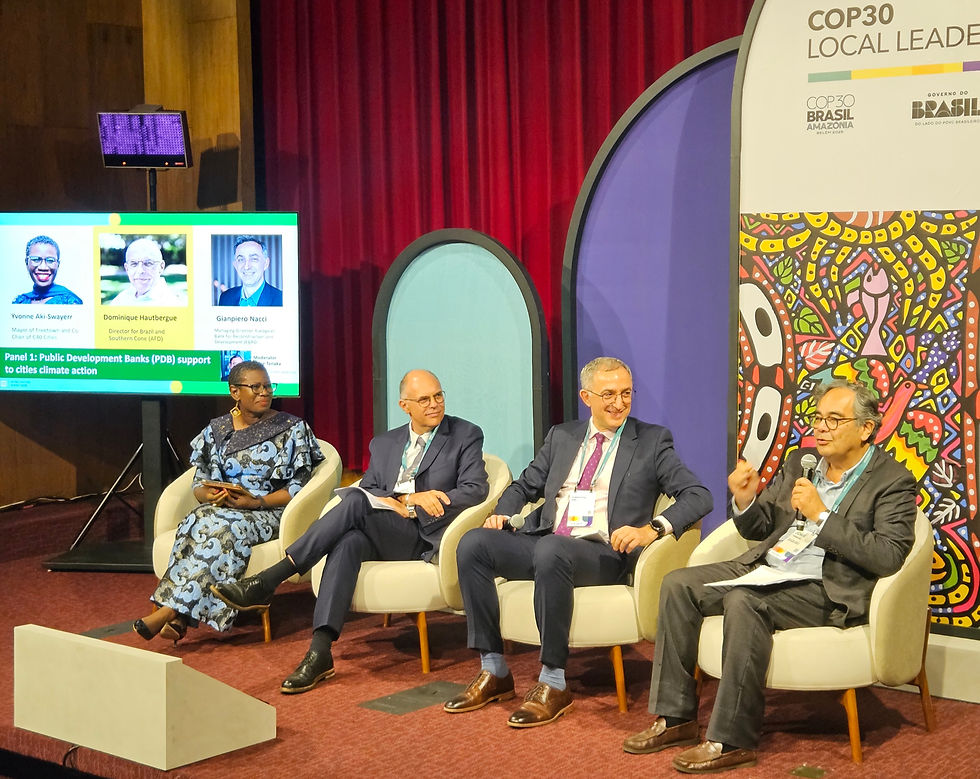
From Sustainability to Urban Well-Being: A Structural Shift
For nearly two decades, global climate discourse revolved around emissions and resilience. But the international community has now recognized a fundamental hierarchy: these factors matter because they directly shape human health. That is the new organizing principle.
Urban planning frameworks are beginning to prioritize metrics such as exposure to air pollution (PM2.5), access to green space, active mobility, heat stress, and food security. Across Europe, Asia, and Latin America, governments are already using health metrics to justify infrastructure investments and to unlock climate finance.
This is not a semantic shift. It is an operational one.Health is no longer a secondary outcome of planning, it has become the criterion that guides planning itself.
The implications are profound for cities aiming to:
prioritize investments under fiscal constraints,
improve institutional performance,
access climate finance through health co-benefits, and
justify high-impact interventions that elevate quality of life.

Implications for Governments and Multilateral Institutions: Evidence-Based Decisions
COP30 and C40 made one point unmistakably clear: urban health allows cities to set priorities with far greater precision than traditional climate indicators. Three signals are shaping the global debate:
First, urgency is now measurable.
Air pollution causes millions of deaths every year (WHO, 2021). The absence of green space can raise urban temperatures by up to 4°C (NASA, 2022). Unsafe mobility and sedentary environments increase healthcare costs and reduce economic productivity (WHO, 2023).
These metrics allow policymakers to evaluate interventions with a level of clarity that carbon inventories alone cannot provide.
Second, multilateral institutions are recalibrating their criteria.
BID, CAF, UN-Habitat, and C40 converged on the same message: urban investments will increasingly need to demonstrate health benefits to remain competitive. Health co-benefits are becoming a central argument for climate financing.
Third, governments need integrated urban intelligence.
Isolated sensors or standalone dashboards are no longer sufficient. Cities require systems capable of linking climate, urban form, mobility, economic dynamics, and well-being within a unified analytical frame. This is precisely what the Healthy Cities narrative enables: a shift from fragmented datasets to integrated, evidence-based decision-making.
The Amazonian Urban Lens: Global Lessons from a Critical Region
COP30 also positioned the Amazon as one of the most critical urban laboratories in the world. Although historically understood as a predominantly rural region, more than 70% of the Amazonian population now lives in cities (UN-Habitat, 2020). These urban centers face a simultaneous mix of rapid expansion, climate fragility, active vulnerability, and service deficits.
But they are also innovating. In Belém, San José del Guaviare, and Georgetown, governments have begun integrating environmental monitoring, geospatial analytics, automated green-inventory systems, and urban modeling tools to anticipate risks and guide public investment.
These experiences underscore a key insight for the post-COP30 global narrative: the world’s most vulnerable cities are showing that integrating health, climate, and data is no longer an aspiration,it is an operational necessity.

GeoAdaptive’s Response: Turning Data Into Urban Well-Being
GeoAdaptive’s Urban & Regional Intelligence portfolio is already aligned with this global shift. Our capabilities integrate:
geospatial intelligence,
urban health analytics,
digital urban systems,
climate-resilience modeling, and
urban climate finance frameworks.
This combination allows us to support cities and governments not only on climate or infrastructure, but through a stronger lens: improving population health through evidence-based territorial decision-making.
As we move toward 2026, GeoAdaptive will deepen this approach through the Urban Health Intelligence Stack, a city-wide operating system connecting urban form, mobility, air quality, heat exposure, ecosystems, economic dynamics, and well-being.
A Well-Being-Centered Urban Contract
The message from COP30 and C40 is unequivocal: urban health will define the future agenda. Cities will increasingly be evaluated by their ability to reduce exposure to risks, enhance well-being, and create safe, equitable environments.
GeoAdaptive embraces this transition with a clear thesis:
Twenty-first-century sustainability is measured in lives improved.


Comments